
Small businesses are continuously searching for methods to improve productivity and efficiency in the fast-paced business environment of today.
With so many opportunities to improve productivity and spur corporate expansion, artificial intelligence (AI) has become a disruptive force. Small businesses can gain important insights, automate repetitive tasks, and provide better customer experiences by incorporating AI tools into their operations.
Understanding AI and Its Impact on Small Businesses
AI is a large area of computer science that focuses on building machines that can carry out operations that normally call for human intelligence. These tasks involve problem-solving, decision-making, and learning.
AI allows machines to perform complex tasks autonomously or with little assistance from humans. It does this through the use of algorithms and data-driven models.
AI solutions provide a competitive advantage to small businesses by:
- Automating tedious jobs, freeing up time for important initiatives.
- Offering data analytics so that choices can be made with knowledge.
- Boosting client involvement with tailored experiences.
Challenges of Implementing AI
Even with the obvious advantages, implementing AI may be difficult for some small businesses due to issues like a lack of technical know-how and financial worries. However, these obstacles are surmountable with the correct strategy and tools, enabling companies to benefit from AI integration.
Criteria for Selecting the Right AI Tools for Your Business
In order for a small business to fully exploit the power of AI tools to streamline its business workflow and harvest a spike in productivity and overall profitability, it is important to analyse some important criteria. These criteria would provide the right insight needed to select the right AI tools that suits the specific needs of a small business.
Assess Your Business Needs
It is critical to assess the unique requirements of your business before choosing AI tools. Determine which areas, like customer service, project management, or administrative tasks, AI can have the biggest impact on.
Evaluate Features of Various AI Tool
Think about features that will support your business goals when evaluating AI tools.
- Scalability,
- compatibility with current systems, and
- ease of use are important factors to take into account.
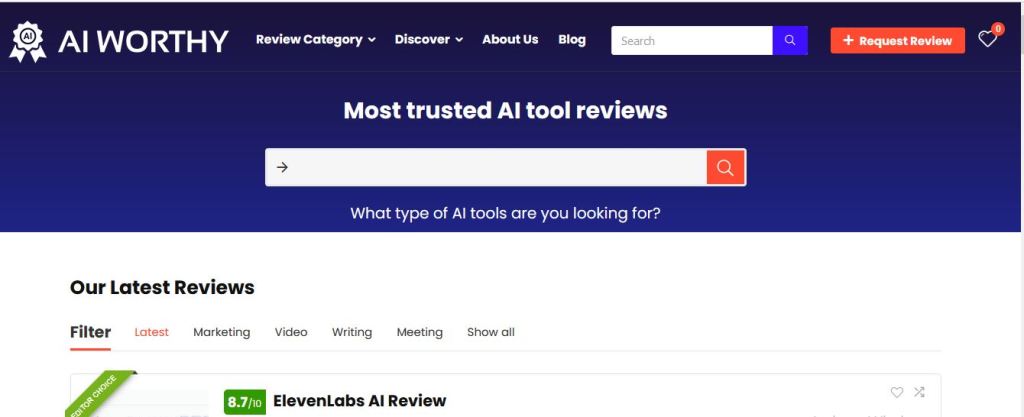
For small businesses, there is mostly a lack of man-power, competence and time, to embark on such a painstaking evaluation process – research is generally tedious and require expert skills to achieve results. But the good news is, a lot of AI startups and businesses exist that provide AI tools evaluation and recommendation as a service to other businesses.
One of such AI businesses is AI Worthy, a company that prides in its own words as;
Our mission is simple, curate a comprehensive list of AI tools that not only enhance your productivity but also revolutionize your workflow. Our in-depth reviews offer unparalleled insights, helping you determine the perfect AI tools tailored to your needs.
AI Worthy, About page
Consider Cost and ROI
For small businesses, cost is a crucial consideration. Compare the possible return on investment (ROI) to the initial investment by taking time savings, higher output, and higher customer satisfaction into account.
Integrating AI Tools into Your Small Business Workflow
Congratulations, you have identified the right AI tool(s) for your business. Now, what next?
Integration is your next port of call as it is not just enough to discover or even purchase the right AI tool for your business. Without properly integrating your new found AI tool into your business, you are more like one who owns a car with no tyres.
It takes careful planning and execution to incorporate AI tools into your business’s workflow. Before launching the tool widely, conduct a pilot program to gauge its efficacy.
Train Your Team to Use AI Tools
Make sure the new AI tools are properly trained for your team. Offer thorough guidance and assistance to ensure a seamless shift.
Adopt Best Practices for A Smooth Transition
To ensure a successful integration of AI tools, adopt best practices such as
- establishing clear objectives,
- keeping lines of communication open, and
- tracking progress.
Track Key Performance Indicators (KPIs)
To evaluate the effectiveness of AI tools, it is important to monitor key performance indicators (KPIs) including time saved, customer satisfaction scores, and error rates.
Analyze performance and pinpoint areas that require ongoing improvement using the data-driven insights gathered from AI tools.
Wrapping Up
To keep your business ahead of the curve, keep up with emerging AI trends like machine learning advancements and predictive analytics.
Encourage a culture of ongoing learning and flexibility within your business to get ready for future advances in artificial intelligence.
For small businesses hoping to succeed in the digital era, artificial intelligence (AI) tools for optimizing workflow are now essential, not optional. Small businesses can achieve new heights of productivity and success by comprehending AI and its advantages, choosing the best tools, and successfully integrating them.
Take the next actions to prepare your business for long-term growth and innovation as it moves toward an AI-driven future.




 TechRusher
Leave a comment